Persona 3 Reload + Episode Aigis
Its going down now…again!
The Journey and The Answer.
Publisher: Atlus
Developer: P-Studio
Platforms: PS4/5, Xbox One, Series, PC, Switch 2
If you’ve checked on my con pictures section, you’ll pick up that I’m a fan of Persona. As in, its a good chunk of my photoshoots, including ones that I personally host or co-host with others. Still, putting on my review hat, its my job to let you know is it worth your time, worth at least the fraction that I myself put into. As of this writing, it is Shin Megami Tensei’s breakout spin off’s 30th anniversary, known as Persona. It is also specifically Persona 3’s 20th anniversary so a round of double dip celebrating is in order. A quick and dirty intro to the Shin Megami Tensei Series, which translates to new or true reincarnation of the goddess has been around in some way or fashion since ‘87, where its predecessor, Megami Tensei was based on a series of novels written by Aya Nishitani called Digital Devil Saga. Essentially Pokemon before Pokemon was a thing, instead of capturing creatures that say their own names, you’re capturing/persuading various people, monsters, gods, goddesses, angels and demons from many mythologies to join your battle. Each have some sort of corresponding element they attack and are resistant to, and are weak to another. We’ll talk Persona’s gameplay specifically later. Because many of these titles came out on Nintendo systems, they stayed on the Famicom due to Nintendo of America’s strict guidelines of religious depictions. For context, even their own published/developed title Devil World never made to American shores initially until its legal release on NSO.
When they added the ‘Shin’ part, it took the ideas and concepts introduced earlier and ran with it. Along they way, they have done main line games, spin off after spin off to see what would stick. Shin Megami Tensei If, the progenitor came out in ‘94 on the Super Famicom, but still failed Nintendo of America’s standards. Sony’s PlayStation with more relaxed standards, Persona made its appearance as Megami Ibunroku Persona, simply known as Revelations: Persona in the West in ‘96. Its sequel, Persona 2: Innocent Sin didn’t make its way stateside initially in 2000, for reasons too long to get into here, but did get a release in 2011 on the PlayStation portable. Its follow up Persona 2: Eternal Punishment did make it, though it leaves Western audiences confused on what it is happening and why, hopefully the appearance of Persona 1 characters would help the confusion.
Persona 3 would come out on the PS2 in ‘06, garnering a cult-like following, then releasing Persona 3: FES a year later to expand on that because downloading DLC wasn’t a thing just yet (Not that it stopped Atlus from re-releasing titles with no cheaper upgrade path over the years.). Katsura Hashino as the director, Shigenori Soejima as the lead artist, and Shoji Meguro as the lead composer, they took over for Kouji Okada, Kazuma Kaneko and Hidehito Aoki from Personas 1 & 2 from here on out. 2012, they released Persona 3 Portable which gave it a visual novel flair, and the addition of playing as a female protagonist. Since then, later entries such as Persona 4/Golden and Persona 5/Royal have launched this niche series into relative mainstream gaming consciousness. So when Persona 3 Reload was announced with a new look, sound and new English voice cast, expectations were high, as well as the fanbase holding its collective breath if it could deliver a fresh take on a classic considered sacred. Takuya Yamaguchi as the director, Azusa Shimada as the lead artist, and Atsushi Kitajoh as lead composer in turn had big shoes to fill.
For the purposes of this review, I’ll be talking about Persona 3 Reload alongside its expansion Episode Aigis, as a complete package to keep in theme with Reload being the ‘journey’ with Episode Aigis being the ‘answer.’ I’ll also avoid major spoilers, though savvy readers may infer on what happened, I encourage those who haven’t played yet to find out the why and how.
Sound: Live and Uncut.

One of the key aspects that set the Persona spin off series apart from its other proverbial siblings was its soundtrack set in the modern day, with sound effects that were ethereal but still real sounding. For 3, the introduction of Japanese hip hop artist Lotus Juice gave it both a slick and raw sound for a genre usually steeped in orchestral, symphonic vibes. New vocalist Kazumi Takahashi takes over for the original Yumi Kawamura keeping in spirit with the original sound, while giving it a fresh spin, playing off Lotus Juice well when they are together in such songs as the revamped battle theme ‘Mass Destruction’, ‘Burn My Dread’. New themes such as ‘Color your Night’ and it new lead theme ‘Full Moon Life’ continues this yin-yang dynamic, belting out banger after banger.
New for Reload is that it is going for more of a live band feel, compared to prior versions that were sample heavy, which made sense considering its hip hop, electronica vibes. Its still here, but its made apparent in re-imagined tracks like ‘ Iwatodai Dorm’ which initially had samples, now Lotus Juice is rapping over it.
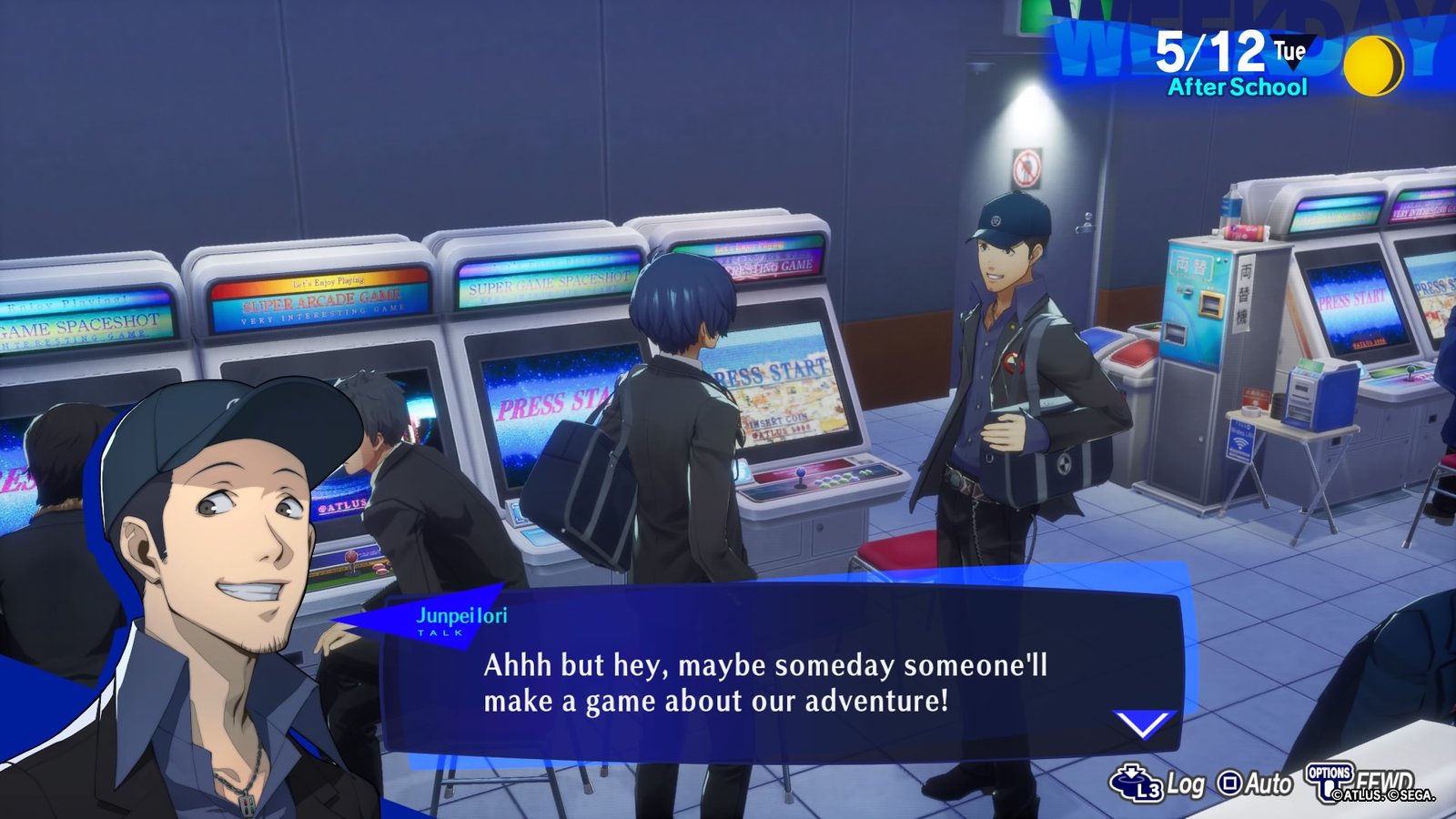
This was the first Persona to have voice work throughout, and until the Persona 3 Portable re-release on PC/Console in ‘23, we only had the English dub to go on, but delivered performances considered timeless. This was a point where the fanbase was unsure when an all new voice English cast was announced whether they could capture the tones and themes expressed here. After the proverbial dust settled, that answer is a resounding yes, and is a teachable moment in that you don’t need to do an impression of another actor, but find the commonality of the character, making it shine through. From Dawn M. Bennet’s Aigis, Justice Slocum’s Shinjiro, Suzie Yeung as Fuuka, Allegra Clark as Mitsuru, Zeno Robinson’s Junpei to name a few, they deliver a masterclass in character interpretation. Lizzie Freeman’s Metis in Episode Aigis nails Metis’ veteran, yet at times childlike status. The option for the original Japanese audio is there, with the original cast intact, re-recorded their lines. While my beginner Japanese skills may not catch every single phrase, to my ears they were able to breathe new life into the their performances as if they did it for the first time.
The rest of the sound effects are competent, from the elemental sounds, Koromaru and the rest of the dogs barking lay into this fine audio production.
Graphics: Smooth 'n Unreal.
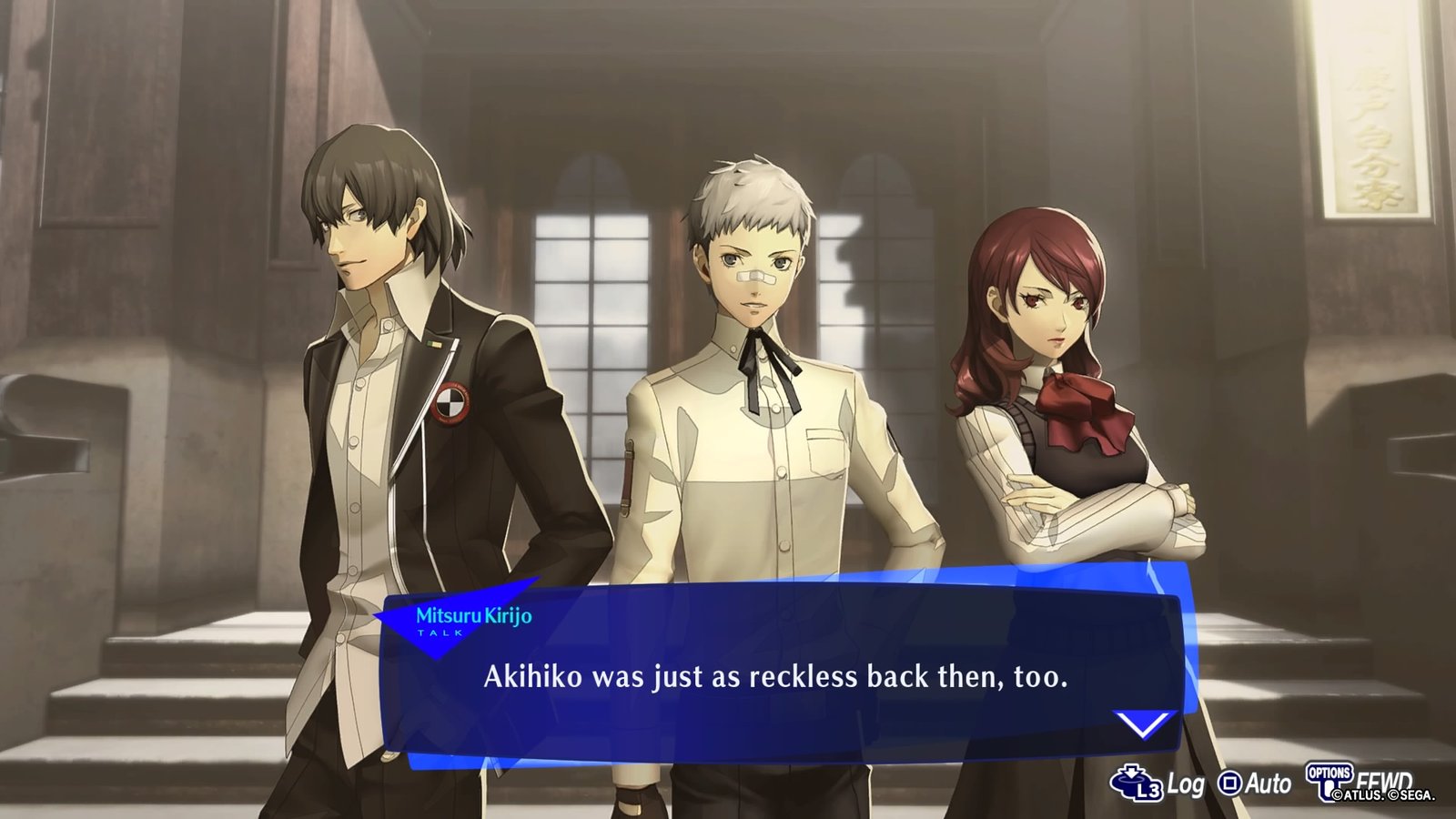
New to Reload is the proportional art style where in previous versions of 3, it had stylized, slighty-bigger-than-chibi-format unless the cutscenes were animated. Using the Unreal Engine 5, it has the slick, stylish straight-out-of-an-anime look that was seen in other formats such as the manga, OVA of the original Persona 3.
Atlus, P-Studio is known for its just as slick user interfaces/menus, and its no different here. The small flourishes when you go from option to option, showing the main protagonist underwater in Reload, and Aigis in Episode Aigis makes it almost its own character. Its not overwhelming or too busy, though its just as lively.
Tatsumi Port Island and its surrounding areas are given the full dimensions just like its inhabitants, making it look like its lived in. Gekkoukan High looks eerily clean, Pauwlonia Mall and its adjacent shopping district nail its suburban-like atmosphere.
When venturing into the Dark Hour and Tartarus it changes its vibe and tone to one of foreboding dread. Tartarus, specifically and its many architectural changes take advantage of modern tech’s lighting capabilities to give it that extra layer of detail. Enemies and boss characters benefit from this as well, making them imposing when they are supposed to.
For Episode Aigis, it changes its theme from being outward and ever expanding, to more enclosed and direct. It reuses assets from Reload but takes them in another direction. Aside from the deceptively open desert hub, it repurposes existing tilesets with expert precision.
Control/Gameplay: Learning is Fun!

From Persona 3 onwards, this is the definition of the ‘school-life JRPG.’ That is to say, Unlike other CRPGs or JRPGS which have you do a grand quest going from town to town, region to region, continent to continent (and in some cases, across time, dimensions, planets) Persona 3 has firmly in the fictional city on the bay Tatsumi Port Island. You play as the blue haired protagonist, any name you wish on him (Though canonically he’s known as Makoto Yuki) who transfers back in after a 10 year absence to Iwatodai Dormitory. Barely having enough time to settle in, you’ll have spooky boy Pharos make you sign a contract, and you’ll notice some strange happenings, people being robbed of desire and motivation. You’ll be soon be drafted to fight monsters known as shadows in the magical time known as the Dark Hour, the time after midnight, where time stands still, and stranger things come about. You are on a barely flexible time frame, as you have the start of the school year from when you transferred, to when you move on to year 3 to figure out the Dark Hour, make friends, get strong enough, get additional weapons, armor, accessories, get as many Personas for the final battle.
Unbeknownst to them, you also have Igor, the long nosed guide who cryptically explains the plot when you sleep, and Elizabeth, now your attendant who keeps track of your your Personas via a compendium and assists in fusing them to create additional Personas. A little later, you realize you’ll have to climb up the tower known as Tartarus getting to know existing allies of the Specialized Extra Curricular Execution Squad or SEES, as well as meeting new ones. Aside from specializing in a particular melee weapon, you’ll summon various creatures, mythological gods and goddess known as Personas which give you elemental powers, divided by the 23 tarot major tarot cards, but also have weakness as well. You as the protagonist (Or protag, or MC) have ability to summon multiple Personas, whereas your allies will master one.
The non-combat gameplay is well explained, you’ll pick up on things such as social links, Persona fusions, leveling up social stats, crafting items, all blend well together. If I went through every thing here, it would make this less a review and more of an instruction manual. It assumes this is your first Persona title, though if it isn’t, its a good refresher, can pay attention to the exclusive features and mechanics Reload brings.
Now for the combat portion, when you and your allies are ready, you can take the night slot and explore Tartarus, the goal is to reach the highest floor you can in that particular run. Once you call it quits for the night, you go into the next day, and while you can usually go again, that night slot doing dungeon crawling means that you’re not improving a social stat, missing a social link, etc. Also, some characters may not be able to join you, they too have their own lives to live. So when you when you are in Tartarus you’ll have to be locked in and make full use of the time you have. This will be an endurance test as while you can get items to heal HP, SP which is Persona’s term for magic, they are expensive by design so once your team gets to a certain HP/SP point, it might be time to turn in. Your various sojourns also have deadlines so if you didn’t complete a certain section, beat a boss by that time, its game over, load up from the previous save.
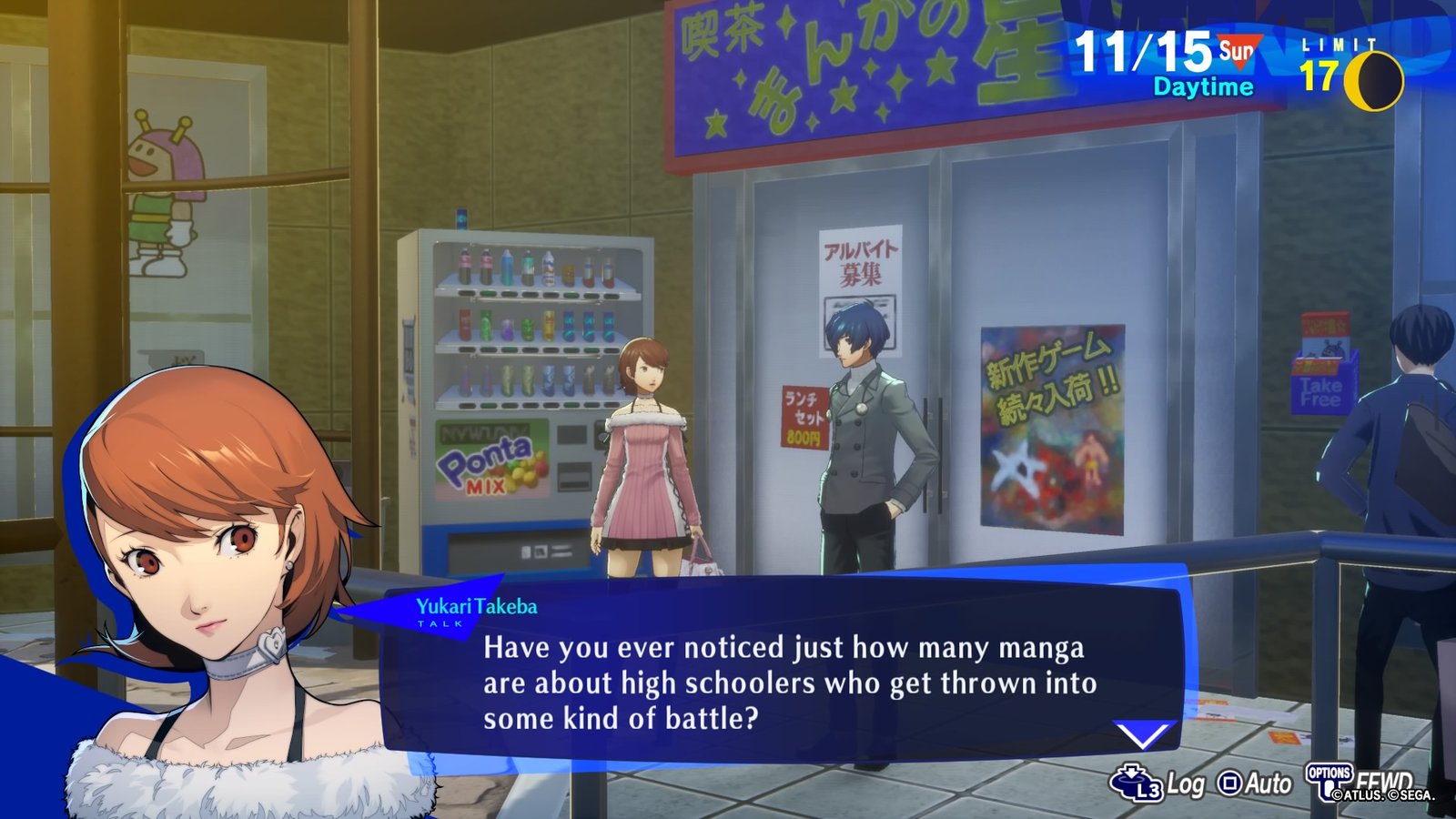
Each of your SEES teammates plays a certain role, and with Reload, you’re encouraged to lean in their specialties. Yukari Takeba for example, our archer surpreme is also the party’s main healer and the more do that, a special meter fills up where you can unleash a Theurgy. Usually, its a special attack that does massive damage, helps to shorten a fight, soften that boss up. Akihiko Sanada aside from his puglism, buffs the crew, and Mitsuru Kirijo debuffs enemies and so on.
For Episode Aigis, it takes place after the events of Reload where they somehow are stuck in a space beyond time, and must work together to make their way back out with the assistance of Metis, Aigis’ sister model who has been there the whole time, as they reflect on the recent journey the undertook. This is much closer to the mainline Shin Megami Tensei titles, where the social aspect/social link is out, and lots of dungeon crawling is in. There are still cutscenes peppered throughout, but the loop that you got accustomed in Reload is replaced with a narrative that is more about reinforcing existing bonds than building up new ones, aside from Metis. You have the option to carry over your compendium from Reload if you wish, which should cut down time needed to recapture, do fusions of higher level Personas again.
Fun Factor: Good Time, Long Time.
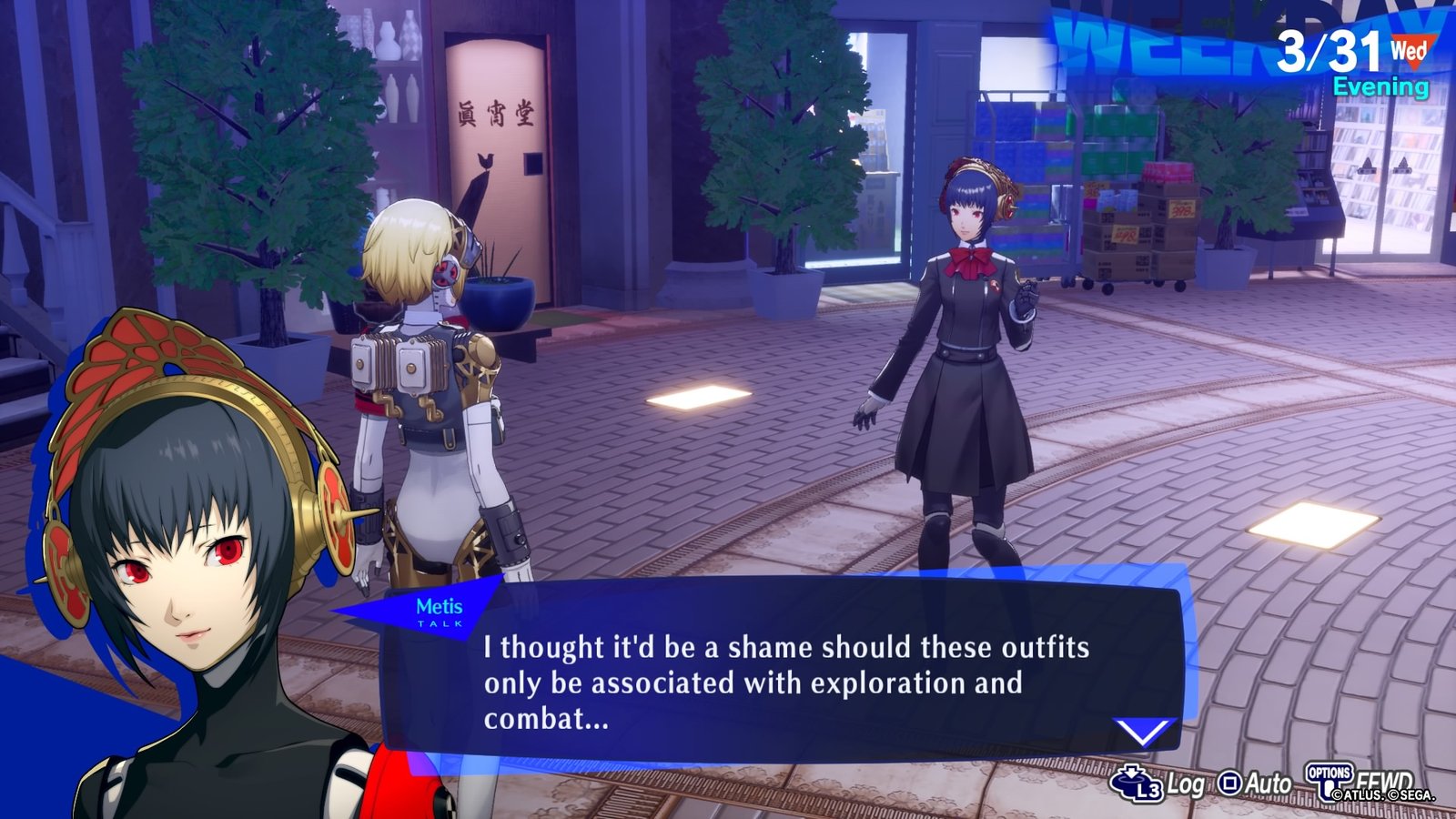
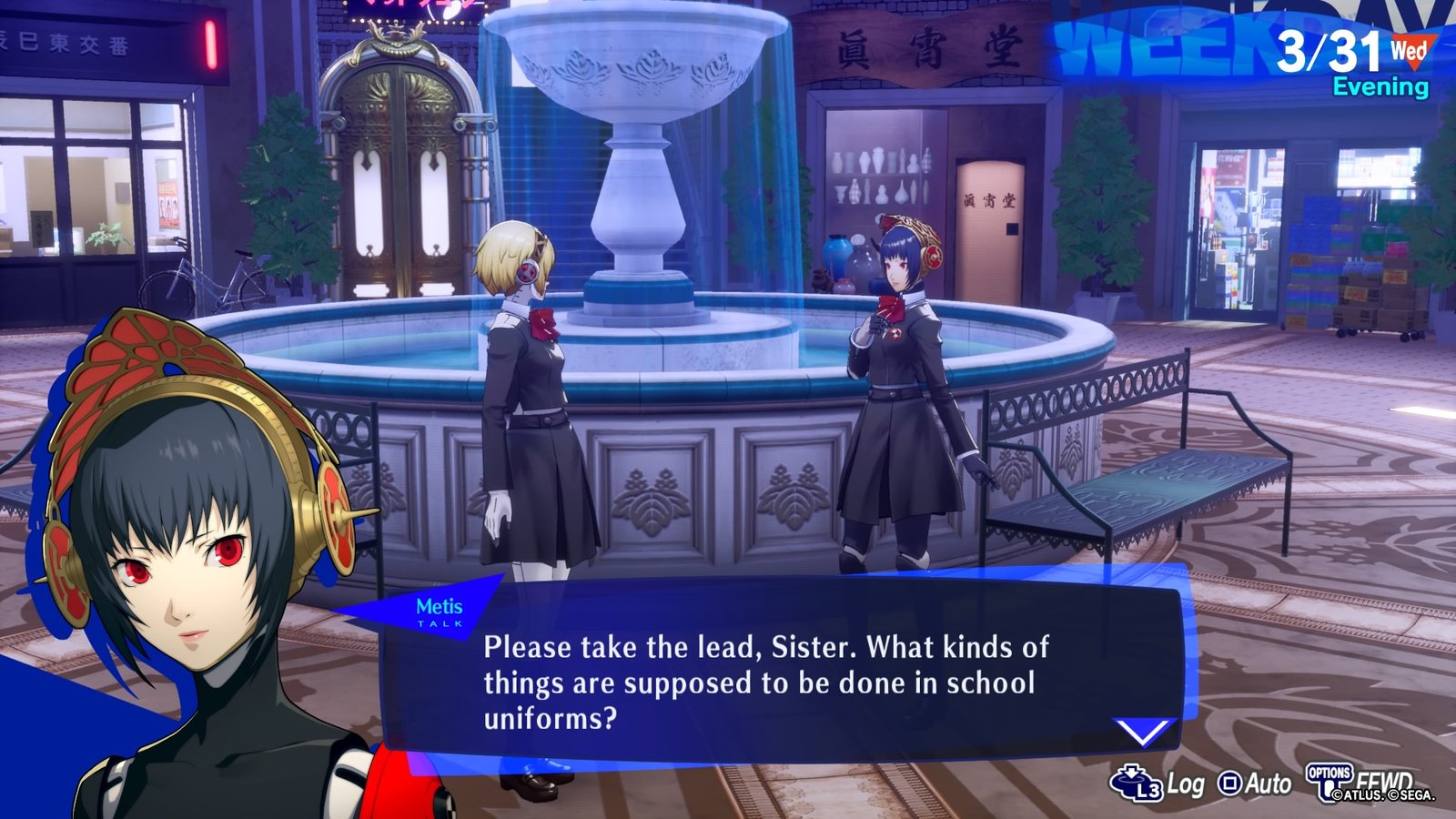
If you get the initial DLC and Episode Aigis, you’ll have the option to change out costumes that from other Persona games, alongside some other colorful ones. You can change the dungeon, battle and boss music as well in the options menu so for series vets, if you want it to sound like other Persona titles, hear remixes.
Persona titles are known to average anywhere from 70 hours minimum, pushing 200 if you max out every social link, capture every Persona, do every side quest. Episode Aigis adds on another 50-70 hours, so will be getting a meaty title that goes the distance, and knows how to pace itself. I acknowledge that in the United States, Atlus titles frequently go on sale, though how much of a discount does vary by platform. Picking it up on sale really does offer the best bang for you buck in terms of content. I also acknowledge that on the PC version, you can add unofficial fan mods to give your adventure some flair, including the addition of adding Persona 3 Portable’s female protagonist. Reload + Episode Aigis is a good place to start if you’ve ever been curious about the series.